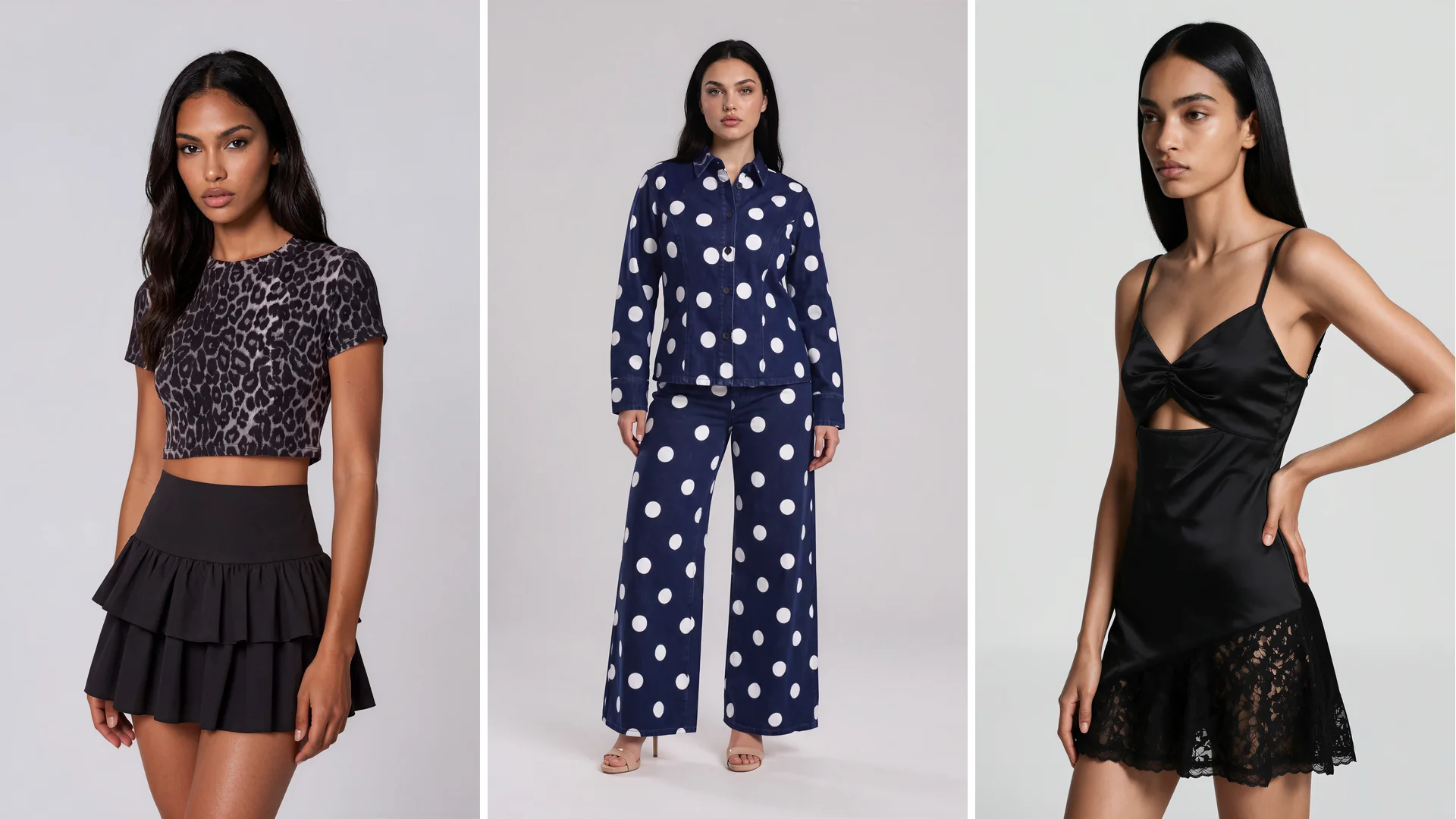
Bulk product photography for eCommerce catalogues
Shooting one product beautifully is a solved problem. Any competent photographer can do it. Shooting eight hundred products to the same standard, on a deadline, while new styles keep arriving, is a completely different discipline.
That is the job most ecommerce fashion teams are actually doing. Bulk product photography is the practice of producing imagery across an entire catalogue to a single consistent standard, rather than shooting products one at a time or in occasional campaign batches.
The difficulty is rarely the photography itself. It is that volume exposes every weakness in the process: scheduling, sample flow, retouching queues, and the slow drift in look that creeps in between one shoot day and the next.
Here is how catalogue-scale imagery actually works, and what changes when you stop treating it as a series of shoots.
Why volume breaks a shoot-based workflow
A shoot is a fixed container. You book a day, fill it with as many products as will fit, and everything that does not fit waits for the next one.
That container does not stretch. When the assortment grows by thirty percent, you do not get a thirty percent longer day. You get another project to schedule, staff, and pay for.
Sample flow is the second constraint, and usually the harder one. Every product in the frame had to physically exist, arrive, and be correct. One late delivery moves a whole block of the catalogue.
Then there is drift. Shoots separated by weeks are lit slightly differently, styled by different hands, and cropped to a slightly different eye. Individually each set looks fine. Side by side on a collection page, the inconsistency is obvious.
What consistency really means at catalogue scale
Consistency is often talked about as a look. In practice it is a specification, and it is worth writing down before you produce anything.
It covers the visual layer: lighting direction and temperature, background treatment, framing and crop ratio, model posture, and how much of the body is in frame for each product type.
It also covers the technical layer, which teams forget until a page slows down. Output dimensions, file format, compression target, and naming convention all belong in the same document.
Some of that specification is set for you. Google's Merchant Center image requirements ask for at least 500 x 500 pixels, recommend 1500 x 1500 or above, and disallow watermarks, promotional overlays, and placeholder images. If your products appear in Shopping listings, that is your floor rather than your target.
That technical half matters more than it sounds. The 2024 Web Almanac media chapter found the median mobile page carries 13 image elements, rising to 56 at the 90th percentile, and that the largest image on a median mobile page weighs 135 KB. Catalogue pages sit at the heavy end of that distribution.
Product images are also frequently the element that determines perceived load speed. Google's guidance on optimising Largest Contentful Paint notes that the LCP element is often an image, which means your product photography is part of your site performance, not separate from it.
Where AI on-model production fits
The reason AI changes this problem is not that it makes images faster. It is that it decouples imagery from the shoot calendar entirely.
Production runs from product images you already have. A flat lay, a packshot, or a ghost mannequin shot becomes an on-model photograph without a sample, a studio booking, or a casting call.
Because the input is a file rather than a garment in a room, volume stops being a scheduling question. Producing four hundred images is the same operation as producing four, run more times.
That is also what makes the specification enforceable. When every image comes out of the same defined pipeline, the look does not drift between batches.

What brands gain from catalogue-wide coverage
1. One standard across every SKU
The hero styles and the long tail get identical treatment. Collection pages stop looking like they were assembled from three different projects.
2. The long tail finally gets covered
Products that never justified a shoot slot get proper on-model imagery. Since most shoppers arrive on a product page rather than the homepage, that tail is doing more work than it gets credit for.
3. Predictable cost per image
Imagery becomes a variable line item that scales with the assortment, so adding two hundred styles has a known cost rather than triggering a new production cycle.
4. Consistent file specs, faster pages
Every image arrives at the same dimensions and compression target, which keeps collection and product pages fast as the catalogue grows.
5. Launches that are not gated by photography
When imagery takes hours, the launch date is set by merchandising rather than by the studio calendar. Restocks and reactive drops become realistic.
6. No dependency on sample logistics
Nothing has to ship anywhere. Imagery can be produced from existing product photography while physical samples are still in transit.
7. Human review at volume
Scale is where quality usually slips. Botika combines proprietary AI with a fashion-trained QA and retouching team, so the standard holds on image four hundred as well as image four.
Sequencing a catalogue rollout
Order of operations matters more than pace. Teams that convert a whole catalogue in one pass usually end up redoing part of it, because the specification changed halfway through.
Start with a single category and finish it completely, including publishing. A category that is live tells you things a test batch cannot: how the images sit next to your existing ones, how they hold up on mobile, whether the crop works in your collection grid.
Then freeze the specification. Once a category is published and approved, treat the document as settled for the rest of the rollout. Changing crop or background midway is what produces a catalogue that looks like two projects.
Work outward by product type rather than by popularity. Types share construction, so a specification that works for shirting will usually work for the rest of your shirting, whereas jumping from a dress to a jacket to a knit tests something new each time.
Keep the old images until the new ones have been live long enough to compare. Reverting is cheap while you still have the files.

How to run a catalogue-scale batch
Start with an audit rather than a brief. List every product type in the assortment and note which ones already have a usable flat lay or packshot, because that inventory determines your starting coverage.
Write the specification next. Decide the crop, the background, the model treatment per product type, and the output file spec, and get merchandising and web to agree before anything is produced.
Then pilot one category, ideally your weakest. Produce it end to end, publish it, and compare performance against the rest of the site rather than against your expectations.
Keep a QA gate as you scale. Review a sample of every batch against the specification, not just the first one, and check images at full size on a real product page. Our time to market solution page outlines how teams sequence this, and flat lay conversion is usually the fastest place to begin.
Common questions about bulk product photography
What is bulk product photography?
It is producing imagery across a whole catalogue to one consistent standard, rather than shooting products individually. The defining challenges are volume, consistency, and keeping up with new styles.
How many images does each product need?
Most fashion brands land on three to six per product: a primary on-model shot, one or two alternate angles, a detail crop, and often a flat lay. Multiply that by your SKU count to get your real annual volume.
How do you keep imagery consistent across hundreds of products?
Write a specification covering lighting, crop, background, model treatment, and file output, then produce everything through one pipeline and QA against that document. Consistency is a process control, not a creative decision made repeatedly.
Can you do bulk product photography without a studio?
Yes. On-model imagery can be generated from product photography you already have, including flat lays and ghost mannequin shots, which removes studio bookings, model casting, and sample shipping from the process.
What is the fastest way to photograph a large catalogue?
Work from existing product images rather than physical samples. That removes the two slowest steps, sample logistics and shoot scheduling, and lets production run in parallel instead of in sequence.
Does producing images at volume hurt quality?
It does if nothing is reviewed. The safeguard is a human QA pass on every batch, which is why Botika pairs its AI with fashion-trained reviewers rather than delivering raw generated output.
Where this is heading
Catalogue imagery is becoming an operations problem rather than a production problem. The brands handling it well have stopped asking how many shoots they can afford and started asking what standard every image has to meet.
Once that standard is written down, covering the whole catalogue becomes a matter of throughput. Begin with one category on on-model photography and measure it before you scale.